Košice
Eastern Slovakia Regional Conference

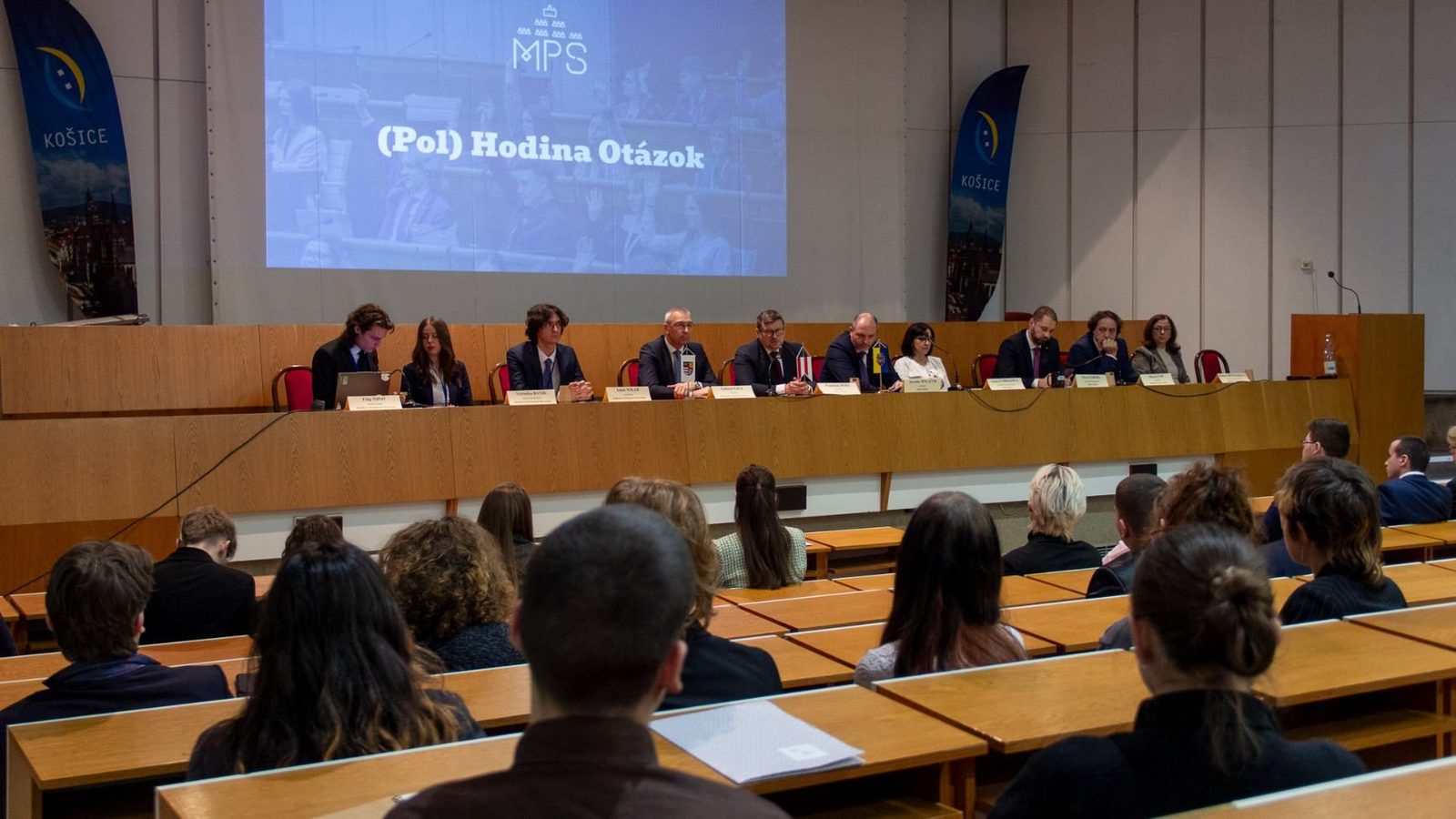
The Eastern Slovakia regional conference took place on 8 and 9 February 2025 at Košice City Hall. More than 50 students from the Košice and Prešov regions took part.
Photo gallery
Committees
Committee on Spatial Planning and the Environment
Sustainability
The climate crisis is bringing more frequent extreme weather, floods and droughts, with serious consequences for the regions. The committee must decide what comes first: coping with consequences that are already here, or investing in prevention and green solutions that reduce future risks. It looks for effective, sustainable measures that protect the environment and regional development while weighing costs against benefits.
Participants will also consider:
- What specific measures should the Košice Self-Governing Region prioritise to soften the impact of extreme weather such as floods and droughts?
- To what extent should regional investment focus on adapting to climate change that is already under way, rather than on preventive green solutions?
- What role should municipalities, towns and the private sector play in supporting sustainability and environmental innovation in the region?
Committee on Cultural Development
Restoration vs. development
How can cultural heritage be preserved and developed for future generations while also supporting tourism and community life? The committee must choose whether to invest mainly in restoring and maintaining existing monuments, or to prioritise festivals, concerts and events that draw visitors and strengthen communities, and what balance and funding sources make sense.
Participants will also consider:
- To what extent should the region's cultural policy reflect national and traditional elements rather than supporting modern art forms?
- Should culture funding follow economic benefit (for example, attracting tourists), or does culture have value rooted in historical heritage?
- How far should cultural policy be decentralised to municipalities and local initiatives, as opposed to a coordinated regional approach?
Committee on Social Affairs
Homelessness
Homelessness is one of today's most visible social challenges. The committee debates how to help homeless people effectively: should they get special benefits, such as subsidised housing, or should restrictions apply to encourage their reintegration? Access to social services, work and housing is key, along with how to fund it and how it affects society as a whole.
Participants will also consider:
- Is it the responsibility of local government to provide long-term solutions for homeless people, or should more of that help come from charities and private initiatives?
- Should benefits and support for homeless people depend on an active effort to find work and improve their situation?
- Should homeless people have guaranteed, unrestricted access to public spaces and services, or should rules apply in the interest of public order?
Committee on Education and Youth
Grammar schools vs. vocational schools
How should money be divided between grammar schools and vocational schools so that it serves both the labour market and young people's interests? Slovakia lacks skilled tradespeople; vocational schools prepare students for work, grammar schools for university, yet not every graduate goes on to study. The committee looks for a balance and for ways to make vocational education more attractive, for example through modern equipment or cooperation with employers.
Participants will also consider:
- Should the choice between grammar school and vocational school be steered more by the state according to labour-market needs, or should students' own interests decide, even if that leads to imbalances between professions?
- Should support for grammar schools be reduced if they do not prepare enough students for university, or does their broader education have value even without a degree?
- How can vocational education stop being seen as a 'second choice' and become an equal, attractive option with good career prospects?
- If vocational education is boosted, is there a risk of the opposite problem later, too many tradespeople and too few university-educated specialists? How can that cycle be balanced?
Ideologies
Traditional left
Stands for social equality and the protection of workers, and supports redistribution and the welfare state. It builds on established forms of social justice and economic solidarity.
Progressive left
Stands for social justice, equal opportunities and an active role for the region in tackling social and environmental problems. It supports investment in public services, green solutions and innovation, and is open to social change and to modernising regional traditions.
Progressive right
Stands for economic liberalism and a free market, and promotes modern innovation, technological progress and some social reforms. It combines right-wing economics with openness to change in society.
Traditional right
Stands for individual responsibility, a free market and preserving regional traditions. It protects traditional social structures, but opposes strong involvement of the regions in the economy.
Want to take part?
We announce registration for the next conference on Instagram. Follow us so you don't miss it.